

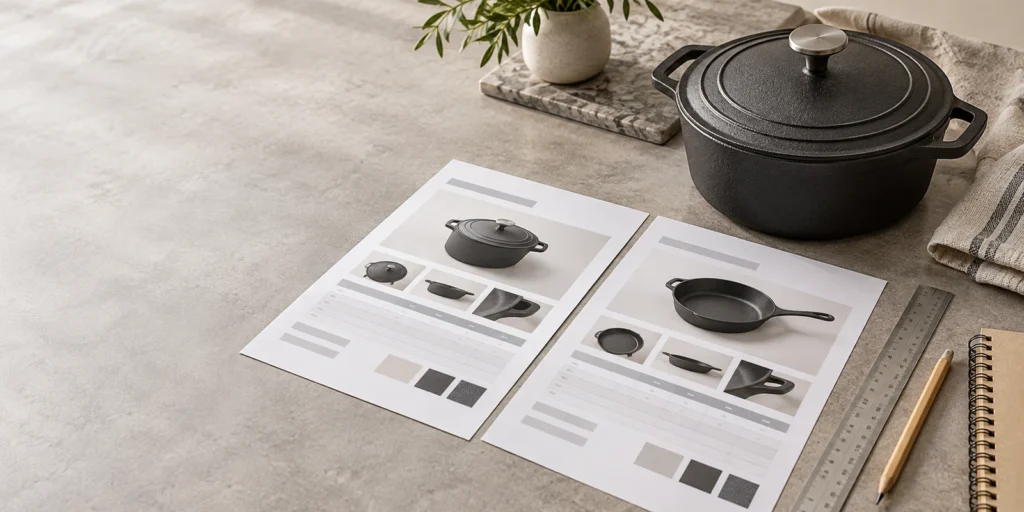
Concept image only; not a current AIRUIPAI SKU or actual supplier quotation. It does not establish any product specification, price, certification, packaging option, stock status or supply capability.
When two cookware quotations look different, the lowest unit price is not always the lowest project cost. A quotation may cover a different product weight, finish, packaging scope or document requirement.
For cast iron and enameled cast iron cookware, buyers should compare the same specification and delivery scope before comparing prices. The questions below help you identify what is actually included in each offer. If you are still defining the project, see How to Prepare a Private-Label Enameled Cast Iron Cookware Project Brief before requesting revised quotations.
1. Compare the Same Product Specification
Start with the physical product, not the price line. If you are comparing factories as well as quotations, How to Choose a Cast Iron Cookware OEM Manufacturer provides the earlier supplier-selection context.
Ask each supplier to confirm the same reference points:
- Product type: for example, a grill pan, griddle or another agreed format.
- Nominal size and actual weight. Two products marked 28 cm may not have the same weight or wall thickness.
- Wall thickness and key dimensions, including the base where relevant.
- Surface treatment or enamel finish, and which requirements apply to the specific sample and target market.
- Lid, knob and handle material and construction.
- Colour reference, sample approval method and how colour differences will be recorded.
Do not compare a lighter sample with a heavier sample and call the difference a supplier price advantage. Record the specification beside each quotation so that the comparison remains traceable.
2. Check What the Quotation Includes, Excludes and Requires
A low-looking quotation may exclude items that another supplier has already included. Ask for a clear answer on:
- Tooling or mould charges, including who pays and how ownership is documented;
- Sample charges and whether any credit arrangement applies;
- Packaging, labels, inserts and outer-carton requirements;
- Carton dimensions, packing quantity and loading assumptions;
- Payment terms, quotation validity and trade terms;
- Sample, approval and production milestones.
These are questions for the supplier to answer. They are not a universal quotation standard and should not be treated as AIRUIPAI policy. Keep the supplier’s answer with the quotation version and date.
3. Check What the Documents Actually Cover
Testing and compliance documents must be matched to the product being purchased. Ask:
- Which product and sample does the document identify?
- Does it state the material and surface treatment that apply to the product?
- Which test items and standards are listed?
- What date and testing conditions are shown?
- Which market or customer requirement is the document intended to address?
- Are there stated limits on product, size, colour, finish or use?
A document for one identified sample should not automatically be treated as evidence for every product, size, colour or market. Request the current document that corresponds to the target SKU and destination market, then keep its scope with the quotation record.
4. Use a Copyable Quote-Comparison Table
Copy the table below into your project file or email and complete it for every supplier.
| Comparison field | Supplier A | Supplier B | Clarification needed |
|---|---|---|---|
| Product type and reference | |||
| Size, weight and wall thickness | |||
| Finish, colour and approval sample | |||
| Lid, knob and handle details | |||
| Tooling or mould charges | |||
| Sample charges and terms | |||
| Packaging and carton assumptions | |||
| Payment and trade terms | |||
| Sample and production milestones | |||
| Document scope and target market |
The purpose is not to choose the lowest number immediately. It is to make sure every supplier is answering the same project question. Once the scope is aligned, you can ask for a revised quotation or share the unresolved points for review.
Share Your Project Brief
If you are comparing quotations for a cast iron cookware project, share the product scope, target market and open questions. The next review should be based on the same information for every supplier.
